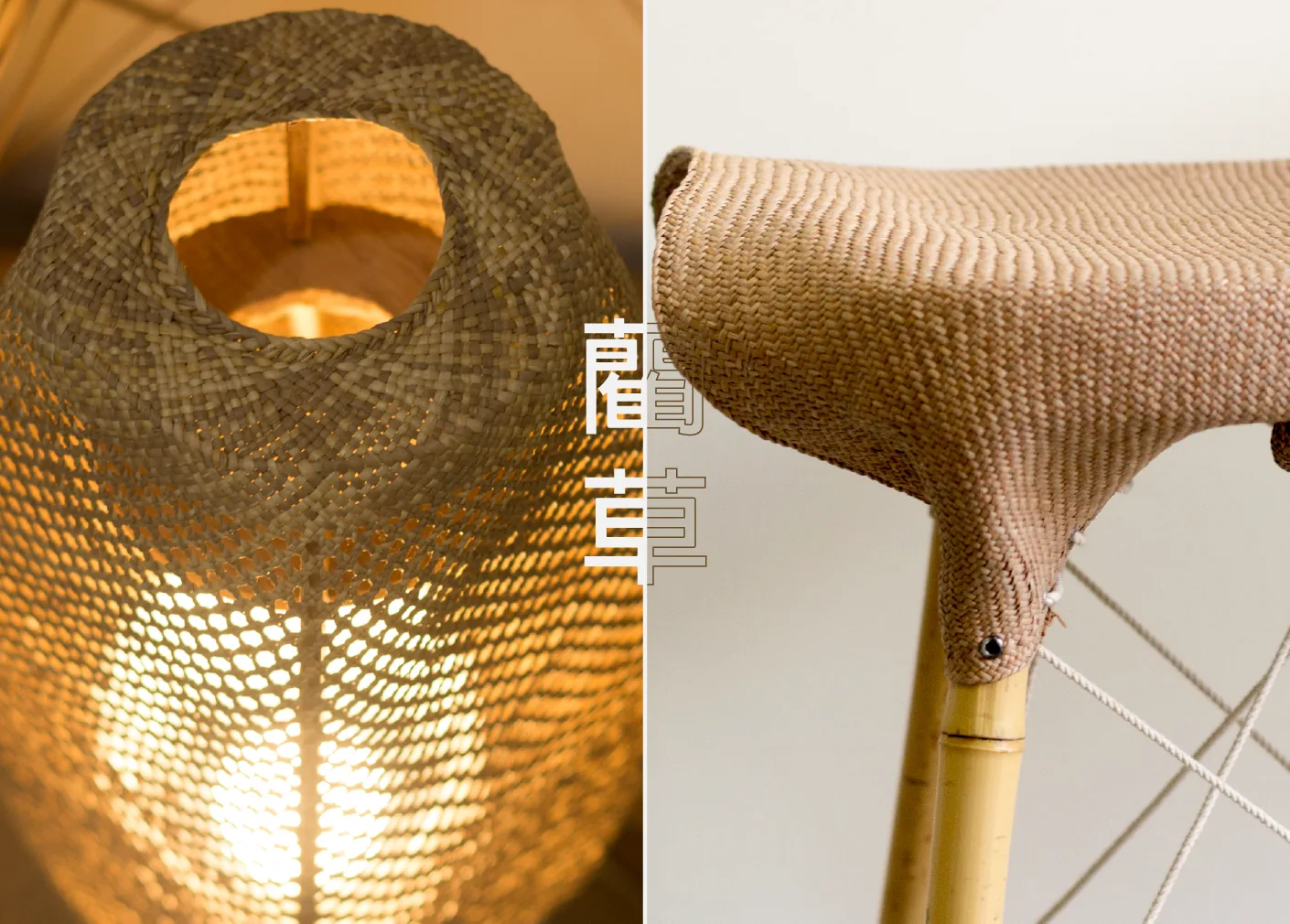
Rush 藺草
Pendant & tension
A two-piece study in Taiwan's rush-grass craft, made with Tunghai University between 2018 and 2020. Pendant weaves rush into a cone and lights it from inside. Tension stretches woven mats over a bamboo frame until they carry a person's weight. Same grass: one filters light, the other holds a body.
Material sourcing
We cut wild rush in central Taiwan's wetlands, dried it for weeks, sorted it by thickness and flex. Traditional weaves went under test twice: for strength, and for how evenly they passed light.
Construction
Tension: hand-cut bamboo legs tied at the T-junctions with cord, woven mats stretched over the frame until their own pull holds the seat firm, no fasteners anywhere. Pendant: a 3D-printed ABS cone wrapped in layered rush, LED and diffuser inside, the weave deciding how much light escapes where.
Pattern iteration
We tested weave after weave. The traditional papaya weave won on both counts, rhythm and structure. Each one got judged twice: light diffusion on Pendant, load spread on Tension.
Specifications
Rush grass, bamboo, LED, ABS · collaboration with Tunghai University · Taichung, Taiwan · 2018 to 2020
Gallery
- Challenges1/2
Tension's frame wobbled and Pendant's LED flickered. We wrapped thread around the bamboo joints, isolated the wiring from the grass, raised the pull on the mats and rerouted the cable inside the cone.
- Insights2/2
Grass over a rigid frame has to be pulled tight at the first assembly, never tightened later. Wiring touching dried grass will find a way to fail.
Swipe to explore